
Why Won’t Metroid Prime 4: Beyond Take off the Training Wheels?
There is something unmistakably missing that should be here in Beyond.
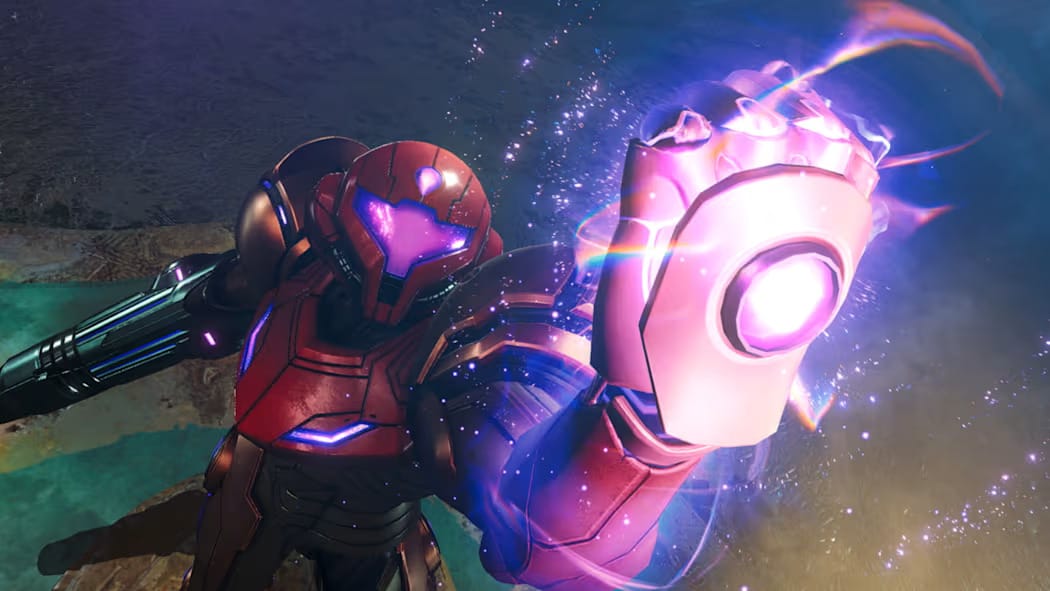
It's 2004, deep within the twilight of the year, and my palms are sweat-slick around a Wavebird Gamecube wireless controller. There's a distinct feeling in the bottom of my stomach, which – aged 10 – I am unable to quite name, or describe. Funnily enough, the series I'm playing will eventually borrow the name of this sensation for one of its own titles. But we're a long way off from that.
The feeling is called 'dread'. It is a palpable sensation dangled equidistant from anticipation and terror. It is excitement's evil twin, and yet all the more seductive. At this particular moment in time, way back in December of 2004, it's keeping me within the confines of a brutally tiny sphere of safety, in the poisonous netherworld of Dark Aether.
Metroid Prime – the series, that is – has been a lot of things to a lot of people. The debut entry into this spin-off series frequently ranks comfortably on 'best games of all time' lists, twenty-three years after its own release. Well, why not? It represented an entire new direction for an IP that was already genre-defining on its own terms, and indisputably nailed it, too. It showed what the pretty damn under-utilised graphics capabilities of the Gamecube could really do, and for my money only its 2004 sequel ever did any better. But more than anything, it gave you a whole world that was truly worth exploring, and then invited you to explore it. No hand-holding. Limited poking and prodding. Just a gloves-off full dive into a captivating and beautiful place. Tallon IV – the first game's setting – doesn't ask much of you. Only, really, that you're curious. And if you are, what it gives in return is unforgettable.
That's Metroid Prime, and it's a long time ago now. Jumping a full twenty-three years to the present day, Metroid Prime 4: Beyond is here to resurrect the series after what can only be described as an utterly agonising wait since 2008's Metroid Prime 3: Corruption, and the very first teaser for a then-unsubtitled Prime 4 back in 2017. The inevitable question has been asked, immediately, by everyone who has laid hands upon it: was it worth the wait? The answer has been something of a resounding shrug.
- - -
Let's get something out of the way: a Metroid Prime game at its absolute worst is still going to stand on its own two feet, no? It would take so much picking and chipping at the formula to break something like this into a genuinely 'bad' game, that by the time you'd done so it would hardly be recognisable as part of the series at all. But there is still definitely something unmistakably missing that should be here in Beyond, something that – by its absence – robs the fourth numbered Prime game of an earnest claim to its own heritage. Plain and simply, that something is hostility.
It's an uncomfortable sensation, as it dawns: the realisation that Metroid Prime 4 is doing the hard work for me. The path forward is always clear, and even then hardly a minute will pass before a voice over the radio kindly intrudes upon your solace to point it out to you directly. 'Hey Samus, maybe the icy mountains would be a good place to test your new fire weapon?' Yes, I think our veteran protagonist might have come to that conclusion herself – and if she didn't, the player certainly would.
Anecdotally, I noticed this uncanny sense of being cradled for the first time when I realised that I had predicted the location of every save station I'd encountered before I knew they were there. So assured was their placement, I could fire off a blast from Samus' arm cannon at a waiting door and saunter confidently into the soft haze of the save station without skipping a beat, knowing even before I'd pulled the trigger exactly what was waiting on the other side.
It's a curious contradiction: on paper, this is the most 'open world' Prime – or any Metroid for that matter – has ever been, by virtue of its sprawling desert hub area. But 'open' is just a hair's breadth from 'empty', and that's just what this desert is. There is little to explore there but the entrances to sub-areas hemmed into the cliffs of its perimeter, and so that is where you go, finding yourself briskly corralled down a shockingly linear series of hallways, natural passages, and chambers that about as often as not have one way in and one way out.
So what, right? Linear games aren't a new concept, nor are linear games that hide it behind a veneer of freedom. Strictly speaking, Beyond isn't really doing anything that Ocarina of Time didn't do with Hyrule Field about thirty years ago. But it matters here, because what this does is have the game hold your hand and guide you through its world. For a tutorial or a prologue, I don't mind this one bit. But hours and hours in, the damn thing wouldn't let go.
- - -
I got lost on Tallon IV. I got lost on Aether, and doubly so on Dark Aether. I got lost hopping between the various worlds of Corruption, trying to figure out where my efforts should be directed. Wander about long enough and the games will throw a hint your way – but tellingly, they give you some time to be lost before they do it, and you can very much still get lost on the way there too. The only time Beyond has allowed me to really wander was when I was fresh out of the Volt Forge with Vi-O-La – Samus' undeniably cool motorbike accessory that facilitates her desert treks. I bounced off the clearly wrong ways to go before arriving at the right one. Even then, the game scarcely gave me a chance to go too far off the beaten path here: I couldn't access the other areas at all until I had satisfied its demands for me to go the right way first.
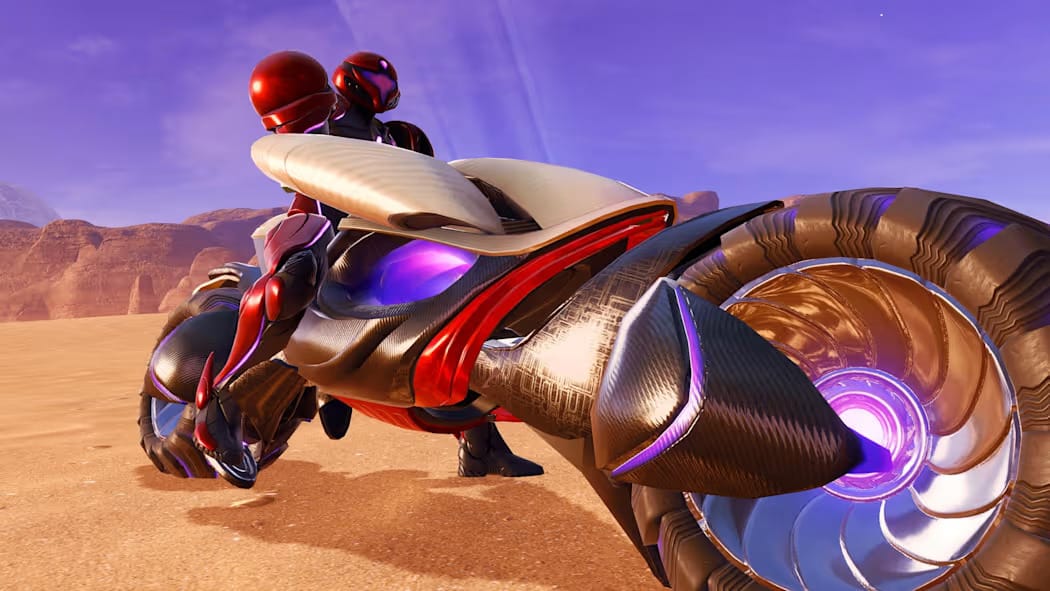
Beyond doesn't want you to wander. Beyond wants you to stay within sight of the kitchen window, so it can see you at all times while it's doing the dishes. If this imagery strikes you as cloyingly parental, then you have a good idea of how the game made me feel: like a toddler in a harness, wondering why I have to go only where mummy and daddy will let me.
Narratively, it strikes me as an odd contradiction too: by this point in the (Prime) timeline, Samus has well and truly earned the right to a lack of direct supervision. And yet it seems that each game in the series only promises more oversight than the last, from total freeform exploration in Prime, to following the beat-by-beat suggestions (instructions?) of your accompanying gaggle of wayward Galactic Federation troops in Beyond. The Federation chain of command is not necessarily clear, but I'm reasonably sure a mercenary that routinely – and single-handedly – brings entire alien species to the brink of extinction is not part of it. Samus Aran should not have to tolerate this babysitting.
And I feel that indignation on her behalf as I play, too. Doesn't she deserve better than to be patronised this way? The alien worlds and the creatures that inhabit them throughout the Metroid series treat Samus with naked and overwhelming hostility, as well they should: it's a mark of respect for who and what she is. When the Ing of Dark Aether in Echoes drop everything they're doing to try and personally screw her over, it feels proportionate to the threat she represents to them.
Dark Samus, too, knows better than most what a threat the galaxy's greatest bounty hunter is and never misses an opportunity to try and eliminate her. In Beyond, though, for some reason everything starts to play fair. A welcome mat is rolled out and never really goes away. Even the attempts at sabotage from this game's primary antagonist serve only to shepherd Samus more or less exactly where she needs to go. If anything, it feels like the planet is personally chaperoning Samus on a tour.
- - -
More than anything this speaks to a lack of faith in the player, and a lack of adventurousness in the level design. These areas are beautiful, make no mistake: the crackling pillars of the Volt Forge set against a sky of violent, violet clouds make an unforgettable impression, ditto the icy winds roaring through the Ice Belt and the vibrant, Feywild-esque tranquility of Fury Green. The soundtrack doesn't let them down for a moment either, and I'm especially enchanted by the choice to really ramp up the music only when generators are kicked into gear and the areas come alive with motion and machinery. But still, let's call a spade a spade: this is set dressing. Captivating as it is, it cannot rehabilitate the shallow level design beneath the surface.
I don't think linear design is a death knell for Prime, but it simply cannot be the default and only option, and it has to serve a greater purpose. Take, for example, a stretch of the Phazon Mines on Tallon IV, sometimes known to fans as 'the gauntlet'. This is a series of rooms in linear sequence between the first save point of the area and the second. Navigating it during backtracking is essentially trivialised by the pickups you acquire later on, but pressing through it for the first time is brutal.
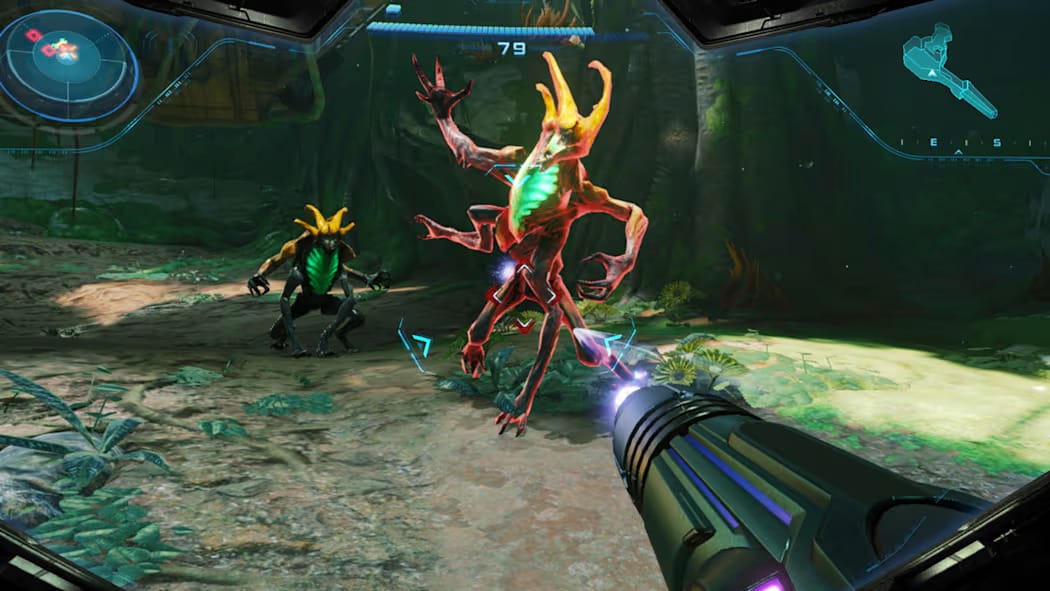
Resource drops are scarce, and encounters with new and powerful enemies frequent. You pray for a save point behind the next door, and then when it's worn you down, you just start praying for health restoration items instead. To unlock your sanctuary at the end, you have to navigate a Morph Ball maze of electric gates, at a point where one nudge too far into an arc of plasma will likely kill you and send you all the way back (yes, this happened to me; no, I'm not over it). It is phenomenal level design, but more than that, it's deeply intentional and deeply hostile. It wants to make you sweat.
In Beyond meanwhile, when I died to an ambush by some ice wolves, the game saw fit to drop me at an unannounced checkpoint immediately before the encounter. The last save station was thirty or so steps further back. This elicited an audible and involuntary sigh.
In short – it matters that a sense of hostility is missing. It matters a great deal to the identity of a series that gave us the Boost Guardian in Echoes, a boss I returned a full six years later in life to finally defeat. Metroid isn't just a series that's meant to be hostile; it is a series about hostility, about how it feels to be alone on a strange world that is trying to kill you any way it can and has a hundred different ways to do so. In Echoes, the air itself is poison, and I could scarcely imagine a better manifestation of what these games are trying to make you feel than that.
It's 2004. I venture beyond the safety of the tiny bubble of light in which I've been shamelessly hiding, tentative as a child going somewhere they know they're not allowed, and my gut drops as malevolent orbs of energy cling around Samus' arm cannon and her health bar begins to plummet. Dread fills me, electrifying and unforgettable. You can only feel this sort of thing from a game like Metroid Prime once, for the very first time. After that, it becomes familiar, and after that it becomes nostalgia. I'll remember that feeling forever.
In twenty years' time, will I remember anything from Beyond? Perhaps only a prevailing sense of disappointment. And maybe not even that.
Comments ()